
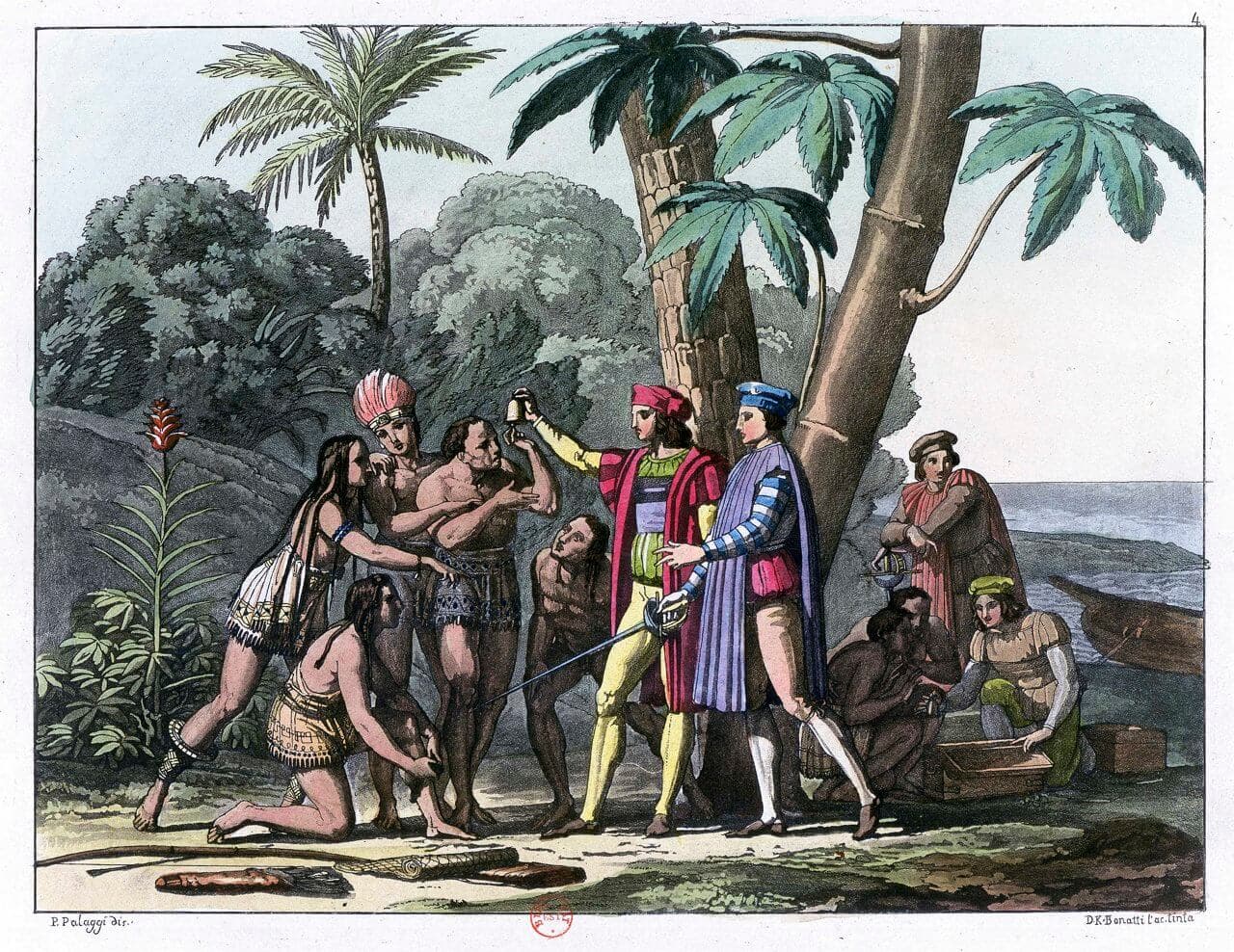
Day of the Discovery of Two Worlds
At a glance
- Next date
- Time left
- 324 days
Date
It is celebrated on October 12th every year. It is a fixed holiday.
Historical Background
October 12th commemorates the arrival of Christopher Columbus in America in 1492. Historically, this date was known as "Día de la Raza" (Day of the Race) in many Spanish-American countries, celebrating Hispanic heritage and cultural mestizaje. However, starting from the late 20th century and early 21st century, there has been a shift in the way this day is commemorated, seeking a more inclusive and critical perspective.
In Chile, as in other nations, there has been an evolution toward a denomination that recognizes the impact of this encounter on indigenous peoples and the resulting cultural diversity. The arrival of Europeans in America signified the beginning of a process of cultural exchange, but also of conquest, colonization, and, in many cases, the annihilation of pre-existing indigenous cultures. The "Day of the Discovery of Two Worlds" or "Encounter of Two Worlds Day" seeks to reflect this complexity, recognizing both Hispanic heritage and the persistence and richness of indigenous cultures.
Enactment as a Holiday
October 12th was declared a holiday in Chile by Ley N° 3.810 of 1921, as the "anniversary of the Discovery of America." For much of the 20th century it was also known as "Día de la Raza."
Over time, and in line with greater awareness of cultural diversity and the rights of indigenous peoples, its name changed. Ley N° 19.668 of 2000 already calls it the "day of the discovery of two worlds" when moving it to Monday, and today it is known as "Encounter of Two Worlds Day," a name that seeks to be more neutral and respectful of all historical perspectives.
Description of the Day
October 12th is a day of reflection on the cultural diversity and mestizaje that characterizes Chile and Latin America. While it is not a day of large popular celebrations, civic and educational events are held that address the complexity of this "encounter."
The focus has shifted from an exclusive glorification of Hispanicity toward a recognition of interculturality and the value of indigenous cultures. In some places, activities are organized that highlight the traditions and contributions of indigenous peoples, while in others, more traditional ceremonies are maintained that recall the Spanish legacy. It is a day to foster dialogue and understanding of the different strands that make up Chilean identity.
Important Facts and Curiosities
• Working Holiday: October 12th is not a non-waivable holiday. This means that commerce and most services can operate normally.
• Change of Name: The evolution of this holiday's name (from "Día de la Raza" to "Day of the Discovery/Encounter of Two Worlds") is a reflection of the debates about history and identity in Chile and the region.
• Latin American Context: Many Latin American countries have redefined the commemoration of October 12th, using names such as "Day of Indigenous Resistance," "Interculturality Day," or "Day of Respect for Cultural Diversity," seeking an approach that values the perspective of indigenous peoples.
• Syncretism: The date can also be seen as a moment to understand the cultural and religious syncretism that resulted from the fusion of indigenous and European elements.
Encounter of Two Worlds Day dates
| Year | Date |
|---|---|
| 2019 | |
| 2020 | |
| 2021 | |
| 2022 | |
| 2023 | |
| 2024 | |
| 2025 | |
| 2026 | |
| 2027 | Upcoming |
| 2028 | |
| 2029 | (preliminary) |
| 2030 | (preliminary) |
| 2031 | (preliminary) |
| 2032 | (preliminary) |
Legal sources
Laws that establish this holiday, on LeyChile (Library of the National Congress of Chile):
Last checked: November 15, 2026.


