
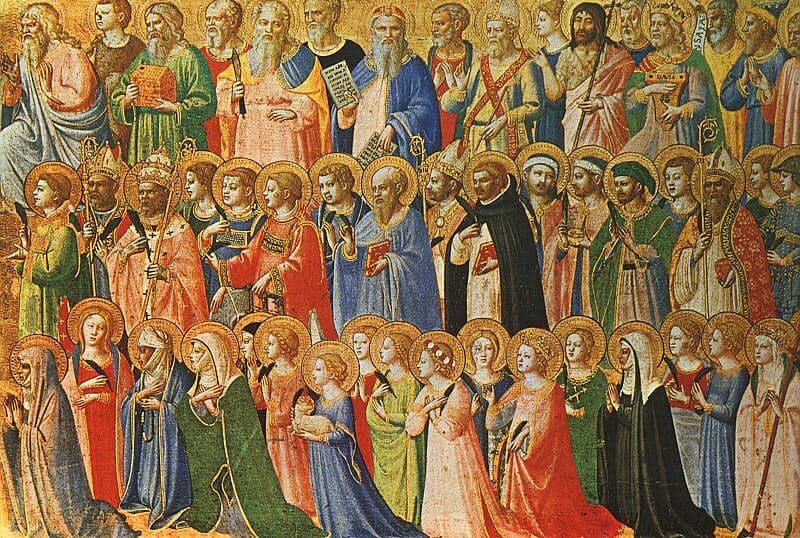
All Saints' Day
At a glance
- Next date
- Time left
- 347 days
Date
It is celebrated on November 1st every year. It is a fixed holiday.
Historical Background
All Saints' Day is a Christian holiday that commemorates all saints, known and unknown, who have reached eternal blessedness in heaven. The Catholic Church, and other Christian denominations, dedicate this day to honoring those who lived a life of exemplary faith and who, according to belief, already enjoy the presence of God.
The origin of this celebration dates back to the 4th century, when some churches began to commemorate martyrs. The date of November 1st was established by Pope Gregory III in the 8th century for the dedication of a chapel in Saint Peter's in honor of "all saints." Subsequently, in the 9th century, Pope Gregory IV extended this observance to the entire Western Church. It is important to distinguish it from All Souls' Day (or Day of the Dead), which is celebrated on November 2nd and is dedicated to praying for the souls of the deceased in purgatory, although both dates are closely linked in popular tradition.
Enactment as a Holiday
In Chile, November 1st was established as a legal holiday by Ley N° 2.977 of 1915, which set several religious and civil holidays in the country. Given Chile's deep Catholic tradition and the importance of this solemnity in the liturgical calendar, All Saints' Day has remained as one of the significant holidays, allowing the faithful to participate in religious observances and, above all, visit cemeteries.
Description of the Day
All Saints' Day is a day of deep religious and family significance in Chile. Although liturgically it celebrates the saints, in popular practice it is a day when Chilean families flock to cemeteries to visit the graves of their deceased loved ones. They bring flowers, clean the graves, pray, and share a moment of remembrance and tribute to those who are no longer here.
Churches also hold special masses in honor of the saints and the faithful departed. It is a day of reflection on life and death, and of reaffirmation of family and community bonds beyond life. For many, it is a deeply rooted tradition lived with solemnity and affection.
Important Facts and Curiosities
• Working Holiday: November 1st is not a non-waivable holiday. This means that commerce and most services can operate normally.
• Cemetery Preparation: In the days leading up to November 1st, cemeteries in Chile usually experience great activity, with people cleaning and preparing their relatives' graves.
• Flower Trade: Florists experience a significant increase in sales in the days before this holiday, given the tradition of bringing flowers to graves.
• Shared Tradition: Although it is a Catholic holiday, the custom of visiting the cemetery and remembering the deceased is a widely practiced tradition in Chile, observed by people of various beliefs.
• Link with Halloween: Like October 31st, this religious holiday is sometimes influenced by the proximity of the Halloween celebration, although their meanings are completely different.
All Saints' Day dates
| Year | Date |
|---|---|
| 2019 | |
| 2020 | |
| 2021 | |
| 2022 | |
| 2023 | |
| 2024 | |
| 2025 | |
| 2026 | |
| 2027 | Upcoming |
| 2028 | |
| 2029 | (preliminary) |
| 2030 | (preliminary) |
| 2031 | (preliminary) |
| 2032 | (preliminary) |
Legal sources
Laws that establish this holiday, on LeyChile (Library of the National Congress of Chile):
Last checked: November 15, 2026.


